Xpra Documentation
Source Code Information
See also dependencies.
These statistics do not include the build or packaging files.
The binary package sizes vary widely, see for example lightweight win32 installations.
Metrics
Reproducing and graphing the statistics
Run the scripts from the repository root with Python 3.12 or newer and Git. Data collection uses the standard library and reads committed Git objects, so it does not require building Xpra, loading codecs, or checking out other branches. Local changes and untracked build artifacts do not affect the results.
Generate the five-branch comparison and publication assets:
python3 fs/bin/source_report_history.py --evolution \
    --cache-dir /tmp/xpra-source-cache --output-dir /tmp/xpra-source-report
python3 fs/bin/source_report_graphs.py /tmp/xpra-source-report/metrics.json \
    --output-dir /tmp/xpra-source-report
The graph renderer requires Matplotlib and runs without a display. The output
directory contains metrics.json, metrics.csv, report.md, and SVG/PNG graphs.
Copy these files together to publish the report. Graphs can be regenerated from
the saved JSON without access to Git. JSON includes the detailed class/module
relationships, file rankings, diagnostics, and metric definitions; CSV contains
one summary row per branch and snapshot.
The default refs are v1.0.x v3.1.x v5.1.x v7.x master. Supply positional refs
before the options to override them. Explicit refs must exist locally; the
collector never fetches. Local branches can lag remote branches, so use explicit
origin/... refs when those are the intended snapshots.
For historical graphs, sample the last first-parent commit in each month or quarter, or version tags on the first-parent history:
python3 fs/bin/source_report_history.py master --evolution --sample quarterly \
    --since 2016-01-01 --cache-dir /tmp/xpra-source-cache \
    --output-dir /tmp/xpra-source-history
--sample tags selects tags matching v[0-9]*; --sample monthly is also
available. --since and --until bound sampling by commit timestamp (ISO dates,
UTC by default); the requested tips are always included. Snapshots sharing a
commit are collected once. Bars compare branch tips as categories; history graphs
use actual commit dates, rather than the original release years. A maintenance
branch tip may be much newer than its first release.
Metric definitions and comparison limits
- Size and files: headline groups are
.py,.pyx+.pxd+.pxi, and.c+.h+.cpp+.m. Per-extension totals and other source extensions are also exported. Scope defaults toxpra/, automatically adapting tosrc/xpra/on older branches. Tests, packaging, and build scripts are excluded by default; override with--pathsas needed. - SLOC: estimated physical source lines excluding blank and comment-only lines. Python docstrings count as code; mixed code/comment lines count as code. Native comment handling is lexical and can misinterpret comment markers inside string literals. KLOC is estimated SLOC divided by 1,000. This is a size measure, not a measure of quality or functionality.
- Codecs: unique identities declared by the codec loader, before platform filtering. Encoder, decoder, converter, filter, and capture roles are listed separately. Counts represent implementations, not unique media formats or libraries installed on the machine. Unresolved loader expressions produce diagnostics and unavailable values, with no package-count fallback.
- Subsystems: implementation modules under historical
mixinsand currentsubsystemdirectories, including toolkit-specific implementations; package initializers and stubs are excluded. Client and server counts include an architecture label. Earlier monolithic versions are not applicable, rather than zero. These structural counts do not claim feature equivalence. - Static CBO: distinct resolvable internal classes referenced by each Python class, including constructors, annotations, and class-member references. Self references and inheritance-only references are excluded; bases are exported separately. Aliases and relative imports are resolved conservatively. Dynamic dispatch, inferred instance types, re-export chains, and string annotations are not resolved. Unresolved references are exported for inspection.
- Module coupling: statically declared internal imports, including imports inside functions and conditionals. Fan-in counts importing modules; fan-out counts imported modules. Dependency cycles are strongly connected groups.
- Sizes: file estimated SLOC and function physical-line distributions
(median, nearest-rank p90, maximum). Function sizes include nested bodies and
docstrings, starting at
def/async def; decorators are excluded. Rankings identify the largest files and functions. - Hotspots: additions, deletions, and file-change frequency over the preceding 365 days, following renames and excluding merge commits. Deleted files can appear in these rankings. This is change activity, not a bug count.
AST metrics apply only to parseable .py files. Coverage reports identify syntax
failures and all excluded non-Python files. An incomplete snapshot still exports
usable size data and available analyses, with explicit diagnostics. Missing
measurements are shown as N/A, never silently changed to zero.
Code age and historical half-life
These analyses are optional and substantially slower than snapshot statistics. They require complete Git history; shallow repositories are rejected. Use a cache directory to reuse completed results.
python3 fs/bin/source_report_history.py master --evolution --age \
    --survival v3.1..master --cache-dir /tmp/xpra-source-cache \
    --output-dir /tmp/xpra-source-lifetime
--age measures the age of each surviving estimated source line at the snapshot,
using blamed committer timestamps. It exports median age in days and age bands.
Negative ages caused by inconsistent commit clocks are clamped to zero. Blame
ignores whitespace changes and detects moves within and between files using
Git’s default thresholds (-w -M -C), including file renames.
--survival BASE..END follows a baseline’s estimated source lines forward using
reverse blame along END’s first-parent history. BASE must be on that history;
a maintenance branch tip usually cannot serve as a baseline for master. Supply
an ancestor release tag or commit instead. Repeat the option for multiple curves.
Baseline lines are tracked independently of newly added code, including edits,
renames, and deletions.
Historical half-life is the elapsed time until at most 50% of the baseline’s lines survive. If that threshold is not reached, the report says not reached and gives the observation duration. An incomplete trace does not publish a half-life or survival curve. Median current-line age and historical half-life answer different questions and are reported separately. Blame provides a heuristic account of textual survival, not semantic equivalence after rewrites.
The existing compact reports remain available without --evolution:
python3 fs/bin/source_report_history.py v1.0.x v3.1.x v5.1.x v7.x master --format markdown
python3 fs/bin/source_report.py --ref master --format json
The table below is an earlier manually published report; its codec counts may use package counts on older branches and its columns differ from the grouped evolution report. Regenerate comparable values with the commands above.
| Ref | Branch Date | Files | SLOC | Py Files | Py SLOC | Pyx Files | Pyx SLOC | Modules | Codecs | Commits Since Base |
|---|---|---|---|---|---|---|---|---|---|---|
| master | 2026-06-05 | 1,073 | 191,733 | 910 | 150,167 | 106 | 30,793 | 1,016 | 38 | 0 |
| v6.5.x | 2026-05-14 | 994 | 177,593 | 852 | 144,087 | 98 | 28,230 | 950 | 32 | 1 |
| v6.4.x | 2026-01-28 | 905 | 165,635 | 780 | 134,818 | 90 | 26,542 | 870 | 31 | 122 |
| v5.1.x | 2023 | 672 | 150,079 | 571 | 120,846 | 69 | 24,826 | 640 | 31 | 1,445 |
| v3.1.x | 2019 | 575 | 124,452 | 491 | 101,459 | 52 | 19,828 | 543 | 19 | 2,130 |
| v1.0.x | 2016 | 373 | 78,116 | 320 | 64,215 | 37 | 13,675 | 357 | 20 | 777 |
Copyrights
Quality
Sonarqube:
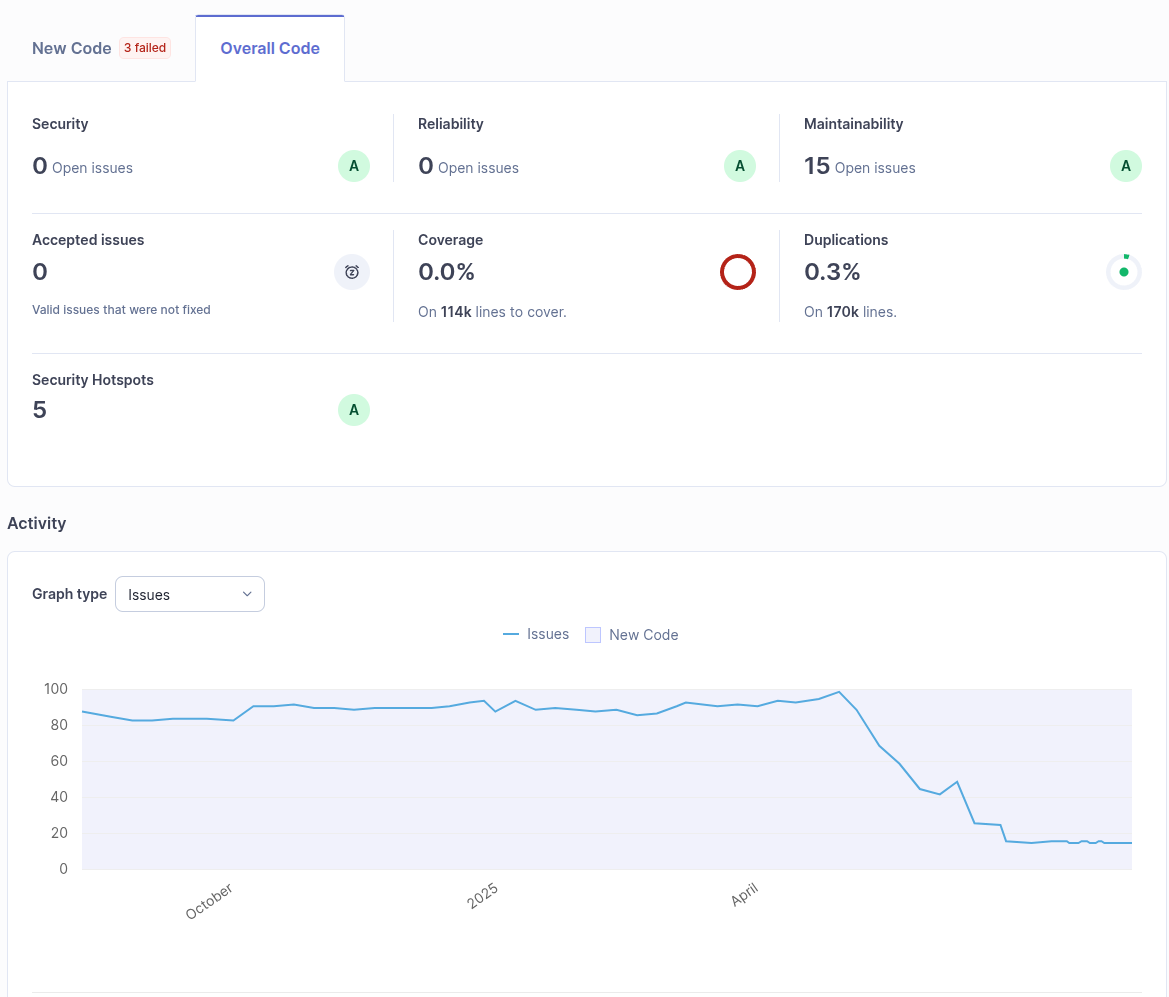 Updated 2025-08-13
The code coverage is not currently recorded by sonarqube.
Github Workflows
The unit tests
are run with every git push via test.yml.
The source code is also compiled with extra cythonization which takes advantage of type hints to verify stronger type safety.
Other linters used
pycharmbuiltin linter, during developmentruffvia a git pre-commit hook